A delivery method for architecture, engineering, construction and operations (AECO) firms or project teams.
Projects start with haste; this is still the norm today, and it creates problems that compound until the end of life of the asset. Unclear scope, schedule and accountability turn design coordination to reactivity early.
I've spent three decades inside AECO project delivery. The pattern is almost always the same. Project strategy is ad-hoc, reacting to whatever demand is loudest. Our people are left scrambling day by day to react to the latest emergency.
What is required is a cohesive system that respects the needs of every person. That connects them intuitively to the data they need, at just the time they need it, and allows them to always know the big picture.
That’s the problem the Razor Method was built to solve.
The Core Idea: People, Workflow, Tools
Software platforms come and go. But the way teams structure information, make decisions, and communicate? That determines whether delivery succeeds or fails.
The Razor Method puts workflow first, technology second, and people always. It's not about adopting another platform. It's about building a system where tools serve the workflow, not the other way around.
Every firm I've worked with has had the tools. Most of them had standards written down somewhere. What they didn't have was a method that made those standards enforceable under real deadline pressure.
Two Layers, One Method
The pattern I kept seeing was the same gap showing up in two places. Firms had no repeatable system feeding their projects, and projects had no structured method running delivery from start to finish. So the Razor Method was built around both.
It operates on two complementary layers. Both are essential. Neither works without the other.
Razor OPS (Operationally Primed for Success) builds the machine. It's the firm-level system of policies, intelligence, tools, people, and workflows that feeds every project. The operating system that ensures delivery doesn't start from scratch each time. It's built once and applied across every job where SHARP will run.
Razor SHARP runs the job. Five principles that prepare each project for success and track its health from start to finish. It's the discipline that turns a good operating system into a predictable project outcome.
OPS builds the machine. SHARP runs the job.
One without the other leaves a gap. A firm with strong operations but no project-level discipline still gets hurt on individual jobs. A team running SHARP principles on a project with no operational backbone is fighting upstream every day.
For firms where the operational backbone is already mature, SHARP can be applied immediately at the project level. OPS remains the deeper system that strengthens consistency and scalability over time, but SHARP does not need to wait for perfection before it begins delivering value.
Razor OPS: The Machine
Every project your firm delivers should benefit from a system that was designed before the project started. That system is Razor OPS.
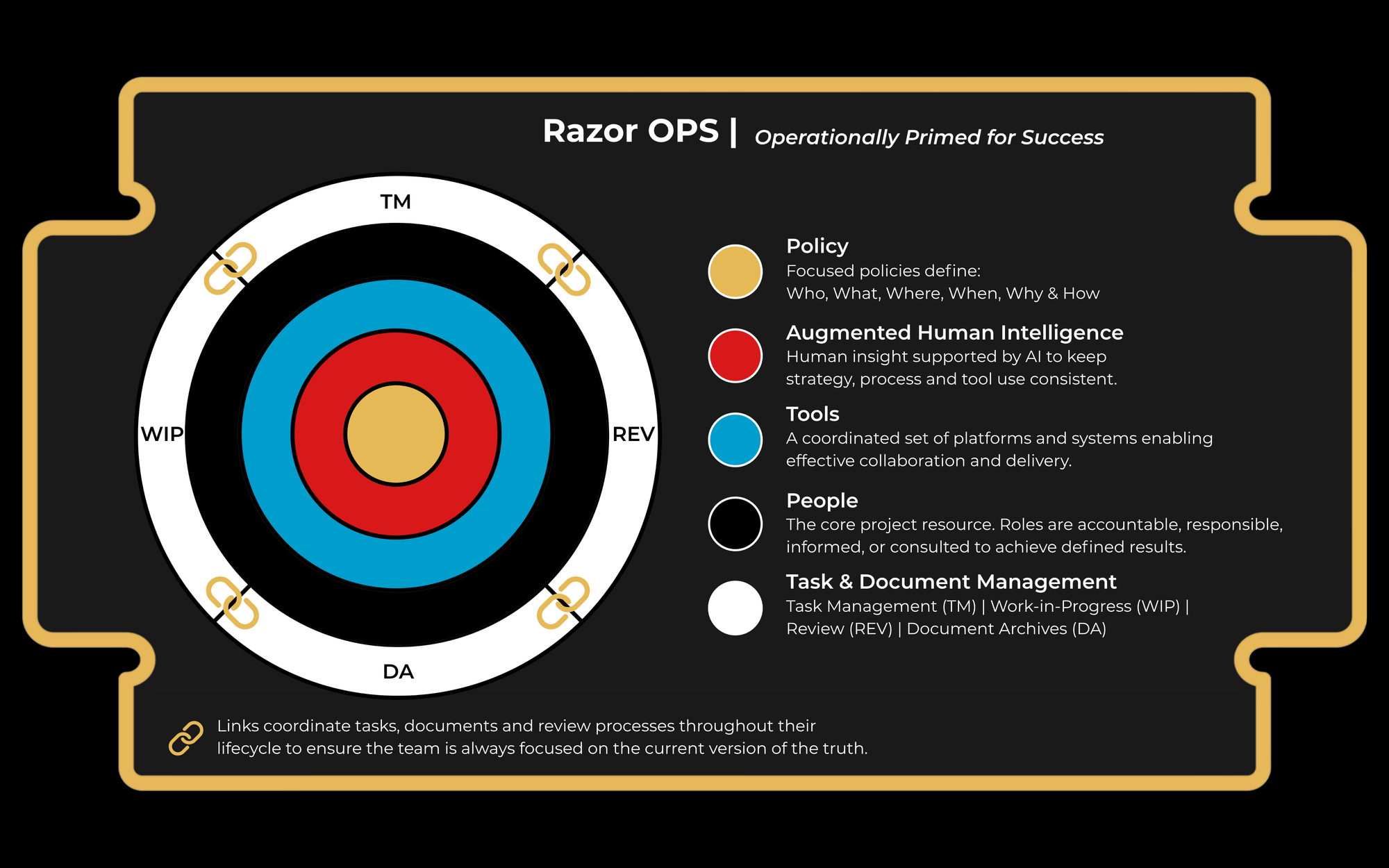
It's structured as a set of interconnected layers, each reinforcing the others:
- Policy sits at the core. Precise, well-structured definitions of the who, what, where, when, why, and how for each task and deliverable. It provides consistent guidance across the entire project lifecycle.
- Augmented Human Intelligence ensures that human judgment remains central while AI amplifies decision-making, captures risk, and keeps strategy consistent.
- Tools form a coordinated ecosystem. The Common Data Environment, QA/QC platforms, task management, and communication channels, each selected and aligned to policy-defined processes.
- People are the most vital resource. Clear policies ensure individuals are accountable, responsible, informed, or consulted for defined outcomes. Role clarity eliminates ambiguity around decision-making and ownership.
- Task and Document Management unites live work-in-progress, formal review, and official publishing into a single structured flow. It governs the full lifecycle of documentation so the firm always knows what's current, what's under review, and what's closed.
These layers aren't linear. They're systemic, and each part reinforces the whole. That's what makes delivery repeatable across projects, not just on one job.
Razor SHARP: The Project Method
Every reactive project I've studied shares the same five failure points. The SHARP principles exist to close each one before pressure hits.
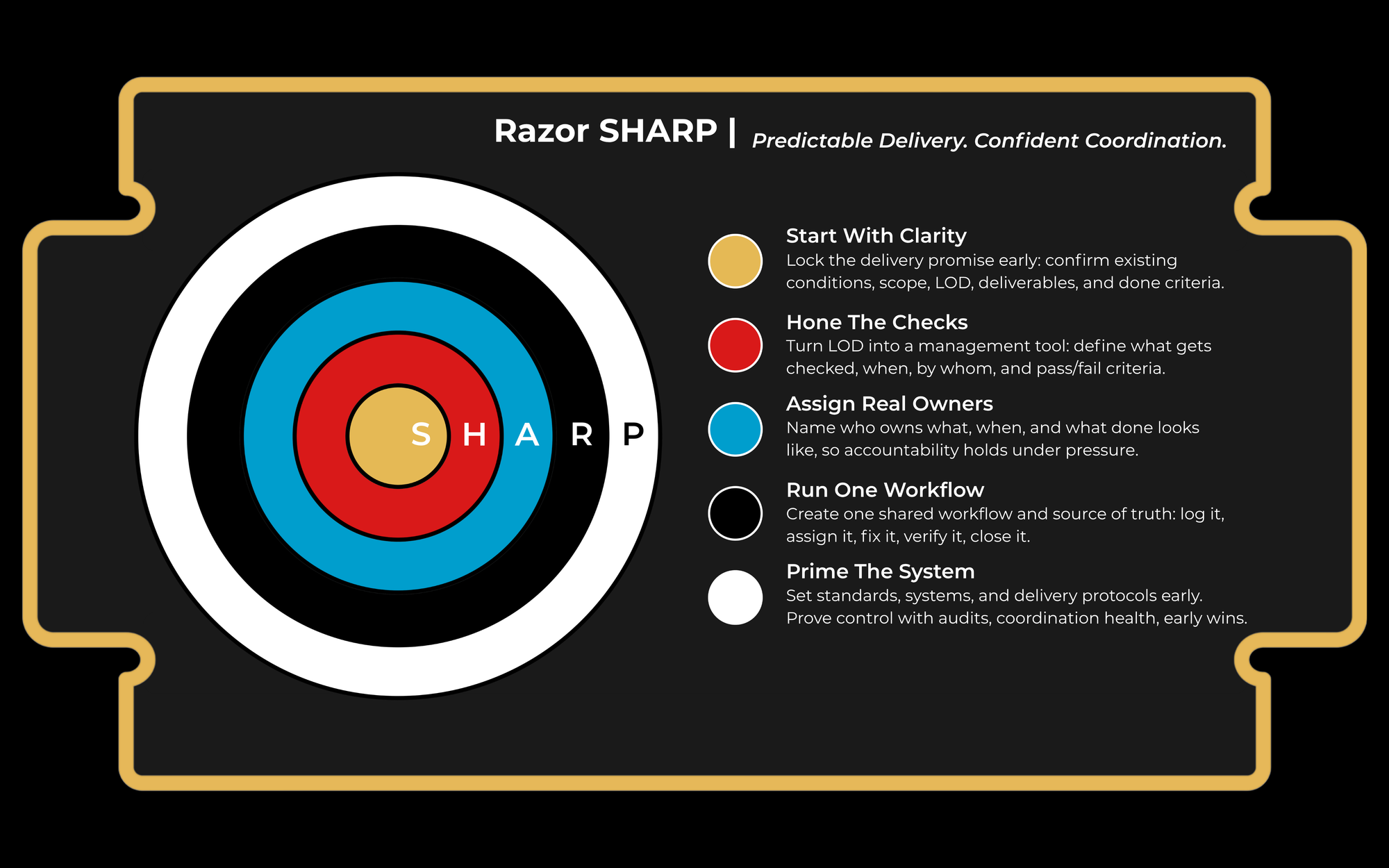
S — Start With Clarity. Lock the delivery promise on day one. Confirm existing conditions, scope, LOD, deliverables, and what "done" means. When everyone builds to the same target, you eliminate the false starts that quietly and consistently burn fee.
H — Hone The Checks. Turn coordination into a real plan, not a calendar invite. Define what gets checked, when, by whom, and with pass/fail criteria. Issues get found early, not at deadline.
A — Assign Real Owners. Name who owns what, when, and what "done" looks like at every stage. When ownership is explicit, accountability holds under pressure. When it's assumed, standards collapse the moment things get tight.
R — Run One Workflow. Create one shared workflow and source of truth. Log it, assign it, fix it, verify it, close it. No duplicate issue logs. No scattered markups across email, chat, and private spreadsheets. One current record of what's open and what's resolved.
P — Prime The System. Set standards, systems, and digital delivery protocols early. Run audits and coordination health checks to prove control before it's demanded. The system is ready before pressure hits. Control is earned, not hoped for.
These aren't aspirational principles. They're the specific points where I've watched projects break, across multiple firms, dozens of projects, three decades of delivery.
Where It Actually Hurts
The research confirms what practitioners already feel. Industry data consistently shows that the majority of rework traces back to poor project data and miscommunication. These are problems that are preventable with better planning and coordination at the front end. Construction productivity has barely moved in two decades while every other major industry has accelerated.
But the numbers tell only half the story.
The real cost is personal. It's the stress your team carries being permanently on the back foot, firefighting daily, never feeling in control. It's the coordination meeting where you realise the miscoordination is deeper than expected, the redesign will take weeks, and every discipline is affected. It's the principal who walks into a client conversation hoping the delivery story holds together. It's the margin leaking quietly and constantly, like a window that was never sealed. You might not feel the draft unless you're standing right next to it, but the heat is escaping around the clock.
The deep fear behind all of it is simple: we're signing up to deliver what hasn't been clearly defined. When that gap shows up downstream, it doesn't feel like a process problem. It feels like leadership didn't have control when it counted.
The Razor Method exists to close that gap. OPS gives you the machine. SHARP gives you the discipline. Together, they turn delivery from something you survive into something you can stand behind.
Where to Start
If your next project can't afford the same start as the last one, that's the conversation worth having.
The clarity call is where we map your current delivery setup against the five SHARP principles and identify where the gaps are. No pitch. No generic recommendations. Just a clear picture of where you stand and what's costing you the most.