Are you ready for predictable project delivery and confident coordination?
Start your next project with clarity. Define the delivery strategy early and assign real owners before kickoff. Hold the pieces of the project in your hands. Stay in control as the design evolves.
Most firms have added the right tools. Most have not yet refined how project delivery works effectively around them.
Over 30 years executing projects across AECO, I've watched the same patterns repeat and compound. Unclear project starts lead to late surprises and leave teams reacting to meet demands day by day.
The Razor SHARP method is how V&RB closes the gaps. Five pillars, applied early, so design intent survives and your team ends the project with reputation protected.

across England, Bermuda, Cayman Islands, and Canada
Rick has spent his career inside the work, not above it.
Razor SHARP is what was learned delivering projects like Belmont Hills in Bermuda, Kapok in the Cayman Islands, and 3 Civic Plaza in Vancouver.
Rick presented at Autodesk University in 2018 on coordinating data-rich models for delivery. The same methods continue to evolve through Razor SHARP.
Does this sound like your projects?
Clients demand it. It's written into every scope. But no strategy exists to clarify responsibilities, expectations, deliverables, or fee. Without one, teams over-model, under-deliver, and burn hours defending work that was never clearly defined.
Before design begins, existing conditions are the only guarantee. Their documentation should be the first deliverable. Without them in place, kickoffs happen and people leave with different assumptions and unclear constraints. Rules, scope, responsibilities, and information needs stay loose. The project runs on pressure instead of a coordinated plan.
Coordination still relies on 2D details rather than the 3D model. What gets checked, when, and by whom is undefined. Problems survive into procurement and construction as RFIs, redesign and rework. The model becomes something the team defends instead of something that drives decisions.
What sits underneath all three?
You're signing up to deliver what hasn't been clearly defined.
When the gaps show up downstream, it feels like a leadership problem, not a process problem.
Find out exactly where your delivery control is exposed. It's free, takes 5 to 8 minutes, and you get instant personalised results.
30 years making sure what gets designed can actually get built.
From unifying architectural and structural CAD packages at Belmont Hills in the early 2000s, to achieving multi-disciplinary model-based coordination at Kapok 20 years later, the principles have stayed the same: define the destination early, align the team around verified information, and remove assumptions before pressure can fracture the system.
Those principles became the Razor Method. The teams who built from it saw the difference on site, and design intent held.
"The project required some complex problems to be solved both structurally and architecturally. Working in and around the existing steel structure was particularly complex but Rick was able in all situations to take it in his stride. The structural package that Rick produced on the Belmont Hills Project is a fine example to any structural technologist of the standards that we strive to achieve. I would recommend Rick for any position be it Architectural, Structural or the dual position"
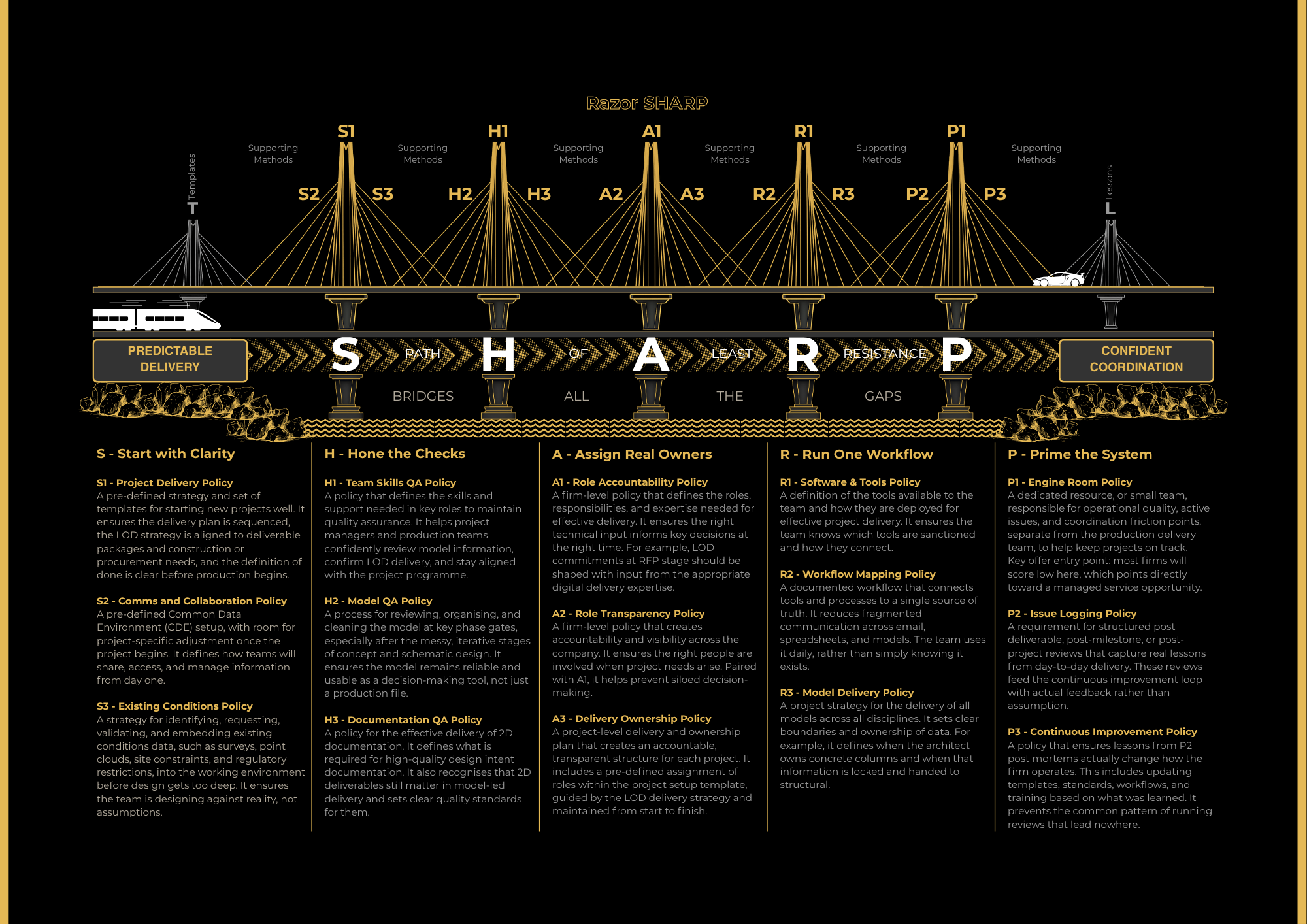
Razor SHARP. Five gap closing principles.
Each one closes a gap where projects begin to break.
Strategise around existing conditions, define the rules of engagement, and coordinate the delivery promise. Include LOD, scope, deliverables, and responsibilities. Agree to what "done" looks like. False starts disappear and strategy adapts respectfully.
Turn coordination and review into an active plan, not a series of meetings. Align what gets checked, when, and by whom to procurement-staged, LOD-focused deliverables. Silos are removed and issues surface early, while there is still time to respond with control.
Ownership is transparent across LOD-based progressions. Everyone knows who is accountable for production, review, and closure. When ownership is explicit, accountability holds under pressure. When it's assumed, standards slip the moment conditions go off track.
One shared workflow. One source of truth. Graphical workflow mapping brings clarity to existing toolsets, showing how information flows and where accountability sits. No duplicate issue logs. No scattered markups across email, chat, and private spreadsheets.
Set standards, systems, and protocols early. Test and refine with regular audits and coordination health checks to prevent pressure building at deadlines. Control comes from preparation and preventative maintenance.
"After loading the files to our total station laser layout system, all dimensions are +/- 1/16". The system cuts down on manpower and time. There is far less chance of human error."
How to Get Started
When the method is applied, this is what changes.
A multi-disciplinary, model-led delivery process was defined before modelling began, with clear LOD targets and deliverables agreed upfront. Coordinated model details reduced 2D detailing by more than 70%, cutting duplication and lowering coordination risk. Quantities were extracted directly from the model, site layout was controlled to within 1/16 inch, and design intent was maintained from design through construction to handover.
"We're in control of delivery" becomes true in practice. Costing and procurement receive coordinated information, not assumptions or 2D duplicated risk. Existing software is applied effectively, reducing redundant administration. Delivery is controlled because the strategy was defined before the work began.
3D spatial coordination ensures tolerances are designed in and clashes are designed out. Clear ownership and smoother handoffs into costing and procurement guide the model to become something the team trusts and builds from, not something they defend after the fact.
Principals walk into conversations knowing the delivery story is tight. Scope, status, and next steps are clear. Uncertainty gets replaced by evidence: you can show what's defined, what's checked, what's owned, and what's closed.
Is this you?
Built for accountable project delivery leads.
Project owners and owner's representatives accountable for outcomes from the client side. You set the conditions every downstream team works within. You want confidence that what you commission can actually be built.
Senior firm leadership accountable for delivery outcomes and client confidence. You have seen enough to know more effort alone will not fix broken delivery.
BIM/VDC leads and senior project managers accountable for the method delivery runs on. You want to champion a proven approach and be given the authority and support to make it stick.
Is now the time?
If any of these hit close to home, the Razor Method was built for this moment.
Problems that showed up late were baked in at kickoff. The rushed start didn't correct itself. It compounded.
A demanding schedule. A complex brief. A reputation on the line. The last project ran reactive and the cost was visible on our team. This time, the delivery promise with an LOD and deliverable strategy needs to be defined before the first model is opened.
You're asking how AI fits into delivery, but it only exposes processes that were built in silos. AI amplifies the mess, it does not resolve it without human intelligence. The firms that benefit first will be the ones whose delivery foundations are already in place.
A free 20-minute call, unlocked by completing the Delivery Control Scorecard and sharing the one thing you would most like under control. Rick reviews your answers before you join.
We look at your specific results, not just the averages. You leave with a clearer read on which pillar matters most for your situation and whether the paid Clarity Call is the right next step.
Who you speak with. Rick Aspin, founder of Vellum & Razor Blades. The same person who built this scorecard and writes every diagnostic in the report.
No pitch. No pressure.
A paid 60-minute call that follows the Discovery Call when there is a clear fit. Your scorecard, open-ended answer, and Discovery Call notes are in front of us when you join, so the call goes straight to the diagnosis.
The first 10 minutes. A quick read on your current project pressure and where delivery is hurting most.
The next 30 minutes. We walk through the one or two pillars where your score signals the biggest risk or the highest-leverage fix. We pressure-test the assumptions behind your answers and identify the gap worth closing first.
The final 20 minutes. You leave with three things:
- The single highest-priority gap to close first, so your next project starts on firmer ground.
- A written plan you can take into your next project and beyond.
- An honest read on whether your team can run this internally, or whether structured support will move it faster.
Outcome over obligation. You leave with a plan whether or not we work together. If our approach fits, we will say so. If it does not, we will say that and point you to your best next move.
Start with clarity.
The Razor Method gives delivery leads a practical, embedded system that works under real deadlines, in the tools you already use.
See the Health CheckComplete the scorecard to unlock a free 20-minute Discovery Call and a personalised plan.